The term “IONK” is becoming more common in text messages, social media chats, gaming conversations, and online communities.
Many people search for its meaning because internet slang changes quickly, and abbreviations often confuse users who are unfamiliar with modern texting culture.
If you have seen someone type “IONK” on Snapchat, TikTok, Instagram, Discord, or in private messages, you may wonder what the person actually means.
Understanding slang terms helps people communicate better online and avoid misunderstandings.
Some abbreviations are harmless and casual, while others may carry hidden meanings depending on the situation.
IONK is one of those internet expressions that can appear simple but may have multiple interpretations based on tone, region, or social platform.
Definition & Meaning
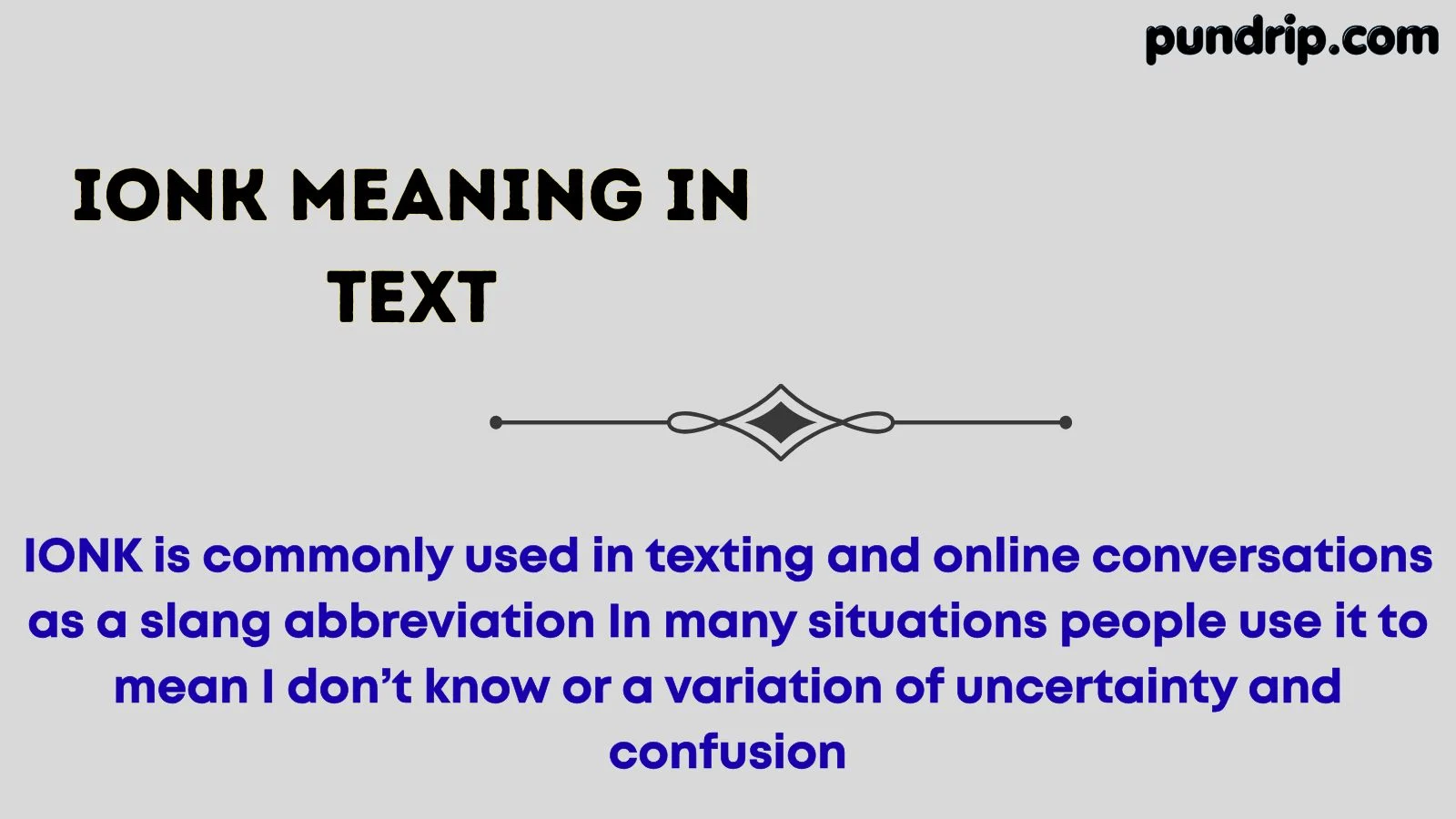
“IONK” is commonly used in texting and online conversations as a slang abbreviation. In many situations, people use it to mean “I don’t know” or a variation of uncertainty and confusion. The abbreviation is mostly informal and appears in casual digital communication rather than formal writing.
The structure of the word follows a pattern similar to many internet slang shortcuts where users remove vowels or shorten phrases to type faster. In some online circles, “ION” already means “I don’t” or “I don’t know,” and adding the “K” can strengthen or complete the phrase. Because internet language evolves naturally, meanings can vary between communities.
Here are a few examples of how people use it:
- “IONK what happened yesterday.”
- “IONK if he’s telling the truth.”
- “IONK why they unfollowed me.”
In these examples, the person is expressing uncertainty, confusion, or lack of information.
Sometimes users type slang casually without following grammar rules. That is why abbreviations like IONK can look unusual to people who are unfamiliar with texting culture. Younger audiences especially prefer short forms because they make conversations faster and feel more relaxed.
Another reason the term gained popularity is that social media platforms encourage quick communication. Apps like TikTok, Snapchat, and Instagram often promote short messages, comments, and captions where abbreviations become common.
Although the most accepted meaning relates to uncertainty or “I don’t know,” users should still pay attention to context. Some online groups may use the abbreviation differently depending on trends or regional slang.
Background & History
The rise of abbreviations like IONK is closely connected to the evolution of internet culture and mobile texting. During the early days of SMS messaging, users had limited character space, so people began shortening phrases into acronyms and slang terms. Over time, these abbreviations became part of online language.
Before smartphones became common, texting on keypad phones was slower. Users created shortcuts like:
- LOL = Laugh Out Loud
- BRB = Be Right Back
- IDK = I Don’t Know
Eventually, internet users started experimenting with more creative shorthand expressions. “ION” became popular in certain online communities as a slang version of “I don’t.” From there, forms like “IONK” appeared naturally in casual communication.
Social media accelerated this trend dramatically. Platforms such as TikTok, Twitter, Snapchat, and Discord encourage fast interaction and viral language trends. Young users especially enjoy creating new slang because it builds identity within online communities.
Music culture, memes, gaming chats, and influencer content also helped spread uncommon abbreviations. Sometimes a term becomes popular simply because creators and influencers repeat it frequently in comments or videos.
Another interesting aspect is pronunciation. Many people do not spell out each letter individually. Instead, they read “IONK” almost like a single word in conversation. This makes it feel more natural in casual speech among younger users.
Despite its growing use, the term still remains relatively niche compared to older abbreviations like “IDK.” That is why many people continue searching online for its exact meaning and usage.
Language on the internet changes constantly, and slang terms often evolve faster than dictionaries can document them. Some abbreviations disappear quickly, while others become permanent parts of digital communication. Whether IONK lasts long-term depends on continued use across social media and texting culture.
Usage in Various Contexts
IONK can appear in many different online situations, and understanding the context is important for interpreting its meaning correctly. The abbreviation is mainly used in informal communication where speed and casual tone matter more than grammar.
Text Messaging
In personal chats, people often use IONK to express uncertainty or confusion. For example:
- “IONK what to wear tomorrow.”
- “IONK why they’re acting weird.”
In these cases, the term replaces a longer sentence and keeps the conversation casual.
Social Media Comments
On TikTok, Instagram, or Twitter, users frequently type slang abbreviations in comments because shorter messages are easier to post quickly. Someone might comment:
- “IONK this trend seems strange.”
- “IONK if this story is real.”
The tone here is usually playful or conversational.
Gaming Communities
Gamers often use internet shorthand while playing multiplayer games. Fast communication matters during gameplay, so abbreviations help save time. IONK may appear in chats when players are unsure about strategies or outcomes.
Group Chats
In friend groups, slang creates a sense of familiarity. Many people use abbreviations naturally because everyone in the group already understands the meaning.
Memes and Humor
Sometimes people use IONK jokingly or sarcastically. Tone plays a huge role online, especially when humor is involved. A person may exaggerate confusion for comedic effect.
Emotional Conversations
In emotional or serious discussions, the abbreviation may sound detached or casual. For example:
- “IONK what to do anymore.”
Here, the phrase reflects uncertainty but may also show emotional frustration.
Because internet slang depends heavily on context, readers should avoid assuming the meaning automatically. Looking at the surrounding conversation usually helps clarify the intention behind the term.
Common Misconceptions & Clarifications
One major misconception is that IONK always has a single universal meaning. In reality, online slang can vary depending on community, age group, and platform.
Some users confuse IONK with:
- IDK (“I Don’t Know”)
- ION (“I Don’t”)
- IK (“I Know”)
These abbreviations look similar, which can create misunderstandings.
Another misconception is that every unfamiliar acronym must have a hidden or offensive meaning. Most of the time, IONK is harmless casual slang. However, context still matters because internet communities sometimes assign alternate meanings to abbreviations.
People also mistakenly assume that slang is grammatically incorrect in all situations. While abbreviations are not suitable for formal communication, they are considered normal in casual texting culture.
Older internet users sometimes believe slang terms are intentionally confusing. In reality, many abbreviations develop naturally through repeated typing habits and online trends.
Clarification is important when communicating with people from different age groups or cultures. If someone does not understand the term, explaining it directly is usually the best approach.
Similar Terms & Alternatives
Several slang terms have meanings similar to IONK. These alternatives are often used interchangeably depending on personal preference and online culture.
IDK
The most common alternative is “IDK,” meaning “I Don’t Know.” It is widely recognized across all age groups.
ION
“ION” is another related term that often means “I don’t.” Some users treat it as a shortened conversational phrase.
IDC
This abbreviation means “I Don’t Care.” Although different in meaning, it appears in similar texting situations.
FR
“FR” means “For Real” and is often combined with uncertainty expressions in online chats.
TBH
“TBH” stands for “To Be Honest.” People sometimes use it alongside IONK during casual conversations.
NGL
“NGL” means “Not Gonna Lie.” It is another popular internet abbreviation commonly used among younger users.
Each abbreviation reflects the relaxed and fast-paced style of online communication. Some are more universal than others, while niche terms like IONK may only appear in certain digital communities.
How to Respond to This Term
Responding to IONK depends on the tone and context of the conversation.
If someone uses it casually, you can simply continue the conversation naturally:
- “That makes sense.”
- “Yeah, me neither.”
- “Let’s figure it out.”
If the meaning seems unclear, asking politely is completely acceptable:
- “What does IONK mean?”
- “Are you saying you don’t know?”
In humorous chats, users often respond with memes, emojis, or playful comments. Meanwhile, serious conversations may require a more thoughtful response.
The key is understanding the emotional tone behind the message. Casual slang works best in relaxed environments where both people understand internet culture.
Regional or Cultural Differences
Internet slang often changes between countries, regions, and communities. IONK may be common among certain English-speaking online groups but unfamiliar elsewhere.
Younger audiences in the United States and other social-media-heavy cultures tend to adopt new abbreviations faster. Meanwhile, users from different linguistic backgrounds may interpret the term differently.
Cultural trends also influence slang popularity. Music genres, gaming communities, and viral TikTok content can spread abbreviations rapidly across regions.
In multilingual communities, users sometimes mix English slang with local language expressions. This creates entirely new forms of internet communication.
Because slang evolves differently worldwide, meanings can shift over time or gain regional variations.
Comparison with Similar Terms
Although IONK resembles many online abbreviations, it carries its own style and tone.
| Term | Meaning | Tone |
|---|---|---|
| IONK | I don’t know | Casual |
| IDK | I don’t know | Universal |
| ION | I don’t | Informal |
| IDC | I don’t care | Dismissive |
| TBH | To be honest | Honest/opinionated |
Compared to IDK, IONK feels more niche and modern. Users who prefer trendy slang may choose it over traditional abbreviations.
However, IDK remains more universally understood and safer to use when communicating with unfamiliar audiences.
Usage in Online Communities & Dating Apps
IONK appears frequently in online communities where fast and casual communication dominates.
Gaming Servers
Discord servers and multiplayer gaming chats often contain abbreviations because players communicate quickly during gameplay.
Social Media Platforms
TikTok comments and Snapchat messages commonly feature slang terms like IONK due to character efficiency and modern trends.
Dating Apps
On dating platforms, users may type:
- “IONK what to put in my bio.”
- “IONK if this app even works.”
In dating conversations, slang can make communication feel relaxed and relatable. However, overusing abbreviations may sometimes appear immature or confusing.
Meme Communities
Memes heavily influence internet slang. Terms gain popularity rapidly when repeatedly used in humorous posts or viral trends.
Online communities constantly create and recycle slang expressions, making internet language highly dynamic.
Hidden or Offensive Meanings
Most uses of IONK are harmless and casual. However, internet slang occasionally develops hidden meanings within niche communities.
At present, there is no widely recognized offensive meaning attached to IONK in mainstream communication. Still, users should remain aware that abbreviations can evolve over time.
Context matters greatly online. A harmless term in one community may carry a different interpretation elsewhere. Before assuming negative intent, it is usually best to examine the full conversation.
Parents, educators, and professionals sometimes worry about hidden slang meanings because social media changes rapidly. Researching unfamiliar abbreviations is a smart way to avoid misunderstandings.
Suitability for Professional Communication
IONK is generally not suitable for professional communication. Workplace emails, academic writing, and business discussions typically require clear and formal language.
Instead of using slang, professional alternatives include:
- “I’m not sure.”
- “I don’t know at the moment.”
- “I need to confirm that information.”
Using internet abbreviations in formal environments may appear unprofessional or confusing, especially when communicating with clients, managers, or colleagues unfamiliar with online slang.
However, casual workplace chats between younger coworkers may occasionally include abbreviations informally. Even then, moderation is important.
Clear communication remains the best choice in professional settings.
FAQs:
What does IONK mean in text?
IONK usually means “I don’t know” in casual online conversations and texting.
Is IONK a bad word?
No, the term is generally harmless and not considered offensive in normal usage.
Where is IONK mostly used?
It is commonly used on social media platforms, gaming chats, and messaging apps.
Is IONK the same as IDK?
They are similar, but IDK is more widely recognized and commonly used.
Can I use IONK in professional emails?
No, it is better to avoid slang abbreviations in professional communication.
Why do people use abbreviations like IONK?
People use them for faster typing, casual tone, and modern internet-style communication.
Conclusion:
IONK is a modern internet slang term mainly used in casual texting and online communication to express uncertainty or lack of knowledge. Like many digital abbreviations, its popularity comes from the fast-paced nature of social media and messaging platforms.
While the term is generally harmless, understanding context is important because slang meanings can vary between communities.
The abbreviation reflects how online language constantly evolves through memes, gaming culture, social apps, and youth communication trends. Although it works well in informal conversations, it is not recommended for professional or academic settings where clarity matters more.
As internet slang continues changing, terms like IONK demonstrate how digital communication becomes shorter, faster, and more expressive over time. Understanding these abbreviations helps users stay informed and communicate more confidently online.

I’m Mike Johnson the creative mind behind Pundrip a space where humor meets imagination and words come alive with personality. I’ve always believed that laughter isn’t just entertainment, it’s a connection. That belief is what inspired me to build a platform dedicated to clever puns, witty wordplay, and content that sparks genuine smiles. My journey started with a simple love for language the way a single word can twist, surprise, and delight. Over time, that curiosity turned into a passion for creating content that feels fresh, original, and full of energy. With Pundrip, my goal is to give readers a place they can visit anytime they need a quick laugh, a spark of creativity, or just a break from the ordinary.