In today’s fast-paced digital world, short forms and slang dominate conversations especially on social media and messaging apps.
One such commonly used abbreviation is TMW. Many people search for its meaning because they encounter it in texts, memes, or online posts and aren’t quite sure how to interpret it.
Understanding slang like this helps you stay connected, avoid confusion, and respond appropriately in conversations.
Whether you’re chatting with friends, scrolling through comments, or exploring online communities, knowing what TMW means can make communication smoother and more engaging.
Definition & Meaning
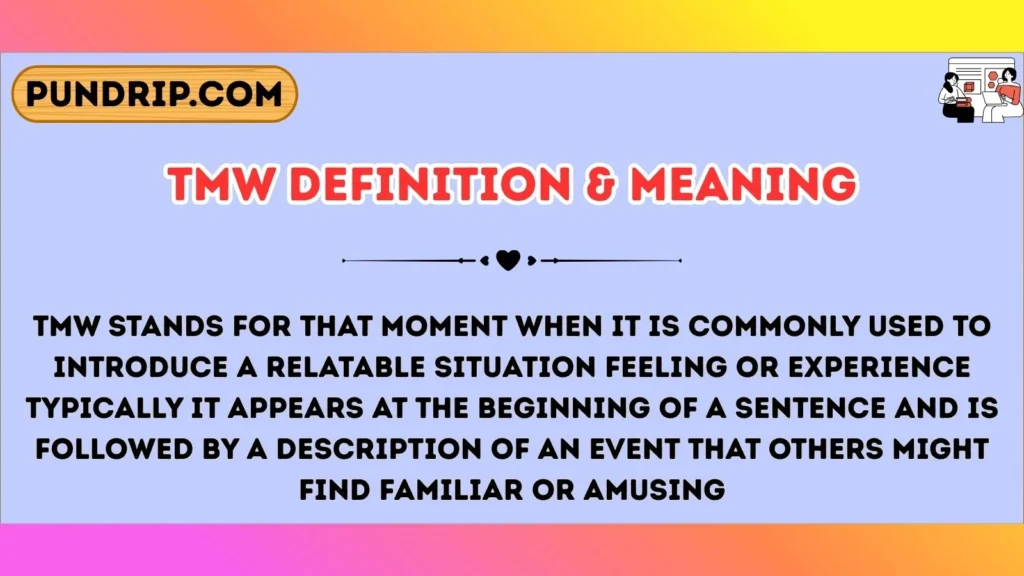
TMW stands for “That Moment When.” It is commonly used to introduce a relatable situation, feeling, or experience. Typically, it appears at the beginning of a sentence and is followed by a description of an event that others might find familiar or amusing.
For example:
TMW you realize it’s Monday again.
In this case, TMW sets up a shared emotional experience—often frustration, humor, or surprise. It works as a shorthand storytelling tool, allowing users to quickly express a moment without writing a long explanation.
TMW is widely used in informal communication, especially in texting, memes, and social media captions. Its simplicity makes it popular among younger audiences, but it’s understood by many internet users across different age groups.
Background & History
The origin of TMW can be traced back to early internet culture, particularly forums and meme-sharing platforms. As digital communication evolved, users began creating abbreviations to save time and space while typing. TMW emerged as part of this trend.
It gained popularity during the rise of meme culture in the 2010s. People started using it as a caption format for relatable images or short text posts. The phrase “That Moment When” was already part of everyday speech, but shortening it to TMW made it more convenient for online use.
Over time, TMW became a recognizable format for expressing shared experiences. Its growth was fueled by platforms like Twitter, Facebook, and Reddit, where brevity and relatability are key.
Usage in Various Contexts
TMW is versatile and can be used in multiple situations depending on tone and intent.
- Humor:
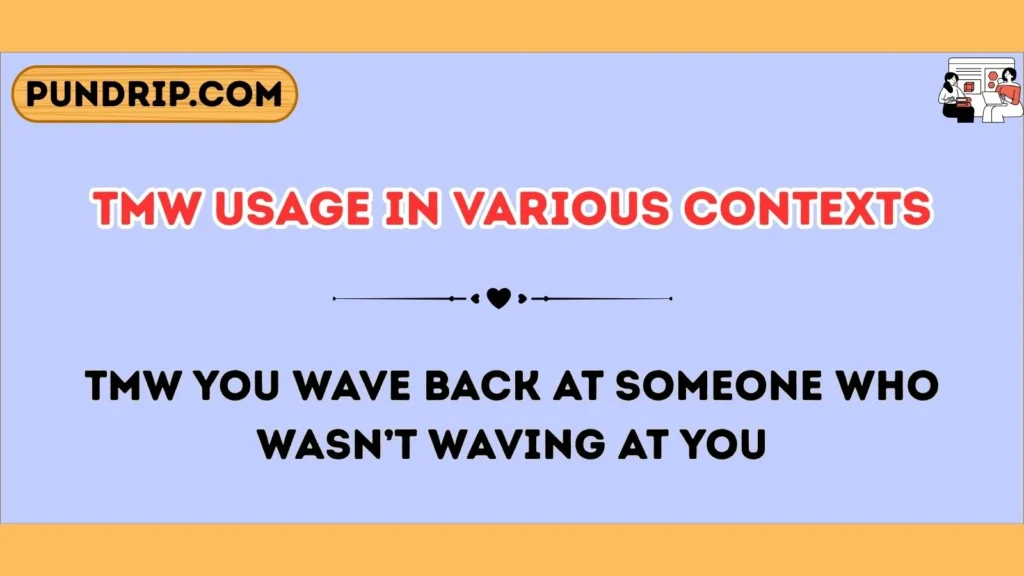
TMW you wave back at someone who wasn’t waving at you. - Frustration:
TMW your internet stops working during an important task. - Excitement:
TMW your favorite show releases a new season. - Embarrassment:
TMW you say “you too” to a waiter who says “enjoy your meal.”
It is often used to connect with others emotionally. By describing a common experience, the speaker invites others to relate and engage.
Common Misconceptions & Clarifications
One common misunderstanding is that TMW has multiple meanings. In most cases, it consistently means “That Moment When.” However, context is still important.
Another misconception is that TMW is formal or acceptable in professional communication. It is not. TMW is strictly informal and should be avoided in workplace emails or official writing.
Some people also confuse TMW with similar abbreviations like “TFW” (That Feeling When). While they are similar, they are not identical in tone or usage.
Similar Terms & Alternatives
There are several alternatives to TMW that convey similar ideas:
- TFW (That Feeling When): Focuses more on emotions
- When you: A more direct and simpler version
- POV (Point of View): Used to present a perspective
- Me when: A casual and meme-friendly alternative
Each of these serves a slightly different purpose but can often be used interchangeably depending on context.
How to Respond to This Term
Responding to TMW depends on the tone of the message.
- Relate to it:
“Haha, that happens to me all the time!” - Add your own example:
“TMW you forget your password right after resetting it.” - React with humor:
“That’s painfully accurate 😂”
The goal is usually to connect, agree, or build on the shared experience.
Regional or Cultural Differences
TMW is widely understood in English-speaking online communities, but its usage may vary slightly across regions. In some cultures, people prefer full sentences instead of abbreviations, while in others, slang like TMW is very common.
Non-native English speakers may take longer to understand it, especially if they are unfamiliar with internet slang. However, due to global exposure to social media, TMW is becoming more universally recognized.
Comparison with Similar Terms
TMW and TFW are often compared because they look and function similarly.
- TMW: Focuses on a specific moment or situation
- TFW: Focuses on the emotional reaction
Example:
- TMW you miss the bus → emphasizes the situation
- TFW you miss the bus → emphasizes the feeling
Both are used in similar formats, but the nuance makes a difference in tone.
Usage in Online Communities & Dating Apps
In online communities, TMW is commonly used in memes, captions, and comment sections to create relatability. It helps users connect through shared experiences.
On dating apps, it can be used in bios or messages to show personality or humor:
TMW you find someone who loves coffee as much as you do.
This makes conversations more engaging and helps break the ice.
Hidden or Offensive Meanings
TMW itself is not offensive. However, the content that follows it can sometimes be inappropriate, depending on the context.
For example, if used to describe sensitive or controversial situations, it may come across as insensitive. Therefore, it’s important to be mindful of the audience and situation when using it.
Suitability for Professional Communication
TMW is not suitable for professional or formal communication. It is best reserved for casual conversations, social media, and friendly chats.
In a workplace setting, using full sentences and clear language is more appropriate. Slang like TMW may appear unprofessional or confusing to some audiences.
FAQs:
What does TMW stand for in text?
TMW means “That Moment When,” used to describe relatable situations.
Is TMW the same as TFW?
No, TMW focuses on a moment, while TFW focuses on feelings.
Can I use TMW in professional emails?
No, it is informal and not suitable for professional communication.
Where is TMW commonly used?
It is popular on social media, memes, and casual texting.
Is TMW used worldwide?
Yes, but it’s more common in English-speaking online communities.
How do I reply to TMW messages?
You can relate, react humorously, or share a similar experience.
Conclusion:
TMW is a simple yet powerful piece of internet slang that captures relatable moments in just a few characters.
Its popularity comes from its ability to instantly connect people through shared experiences, whether humorous, awkward, or emotional.
While it’s perfect for casual conversations and online interactions, it’s important to use it appropriately and avoid formal settings.
By understanding its meaning, context, and variations, you can confidently use TMW in your digital communication and better interpret what others are saying.
As online language continues to evolve, staying familiar with terms like this ensures you remain engaged and in the loop.

I’m Mike Johnson the creative mind behind Pundrip a space where humor meets imagination and words come alive with personality. I’ve always believed that laughter isn’t just entertainment, it’s a connection. That belief is what inspired me to build a platform dedicated to clever puns, witty wordplay, and content that sparks genuine smiles. My journey started with a simple love for language the way a single word can twist, surprise, and delight. Over time, that curiosity turned into a passion for creating content that feels fresh, original, and full of energy. With Pundrip, my goal is to give readers a place they can visit anytime they need a quick laugh, a spark of creativity, or just a break from the ordinary.